
What is Galectin-3 and why quantify it?
Galectin-3 (gene: LGALS3) is a β-galactoside-binding lectin involved in cell adhesion, endocytosis, and glycan-mediated signaling. Core background and nomenclature are available at NCBI Gene (nih.gov) and related resources:
NCBI Gene LGALS3 (human) — ncbi.nlm.nih.gov/gene/3958 (NIH)
MeSH immunology terms — meshb.nlm.nih.gov (NIH/NLM)
NCI Thesaurus (terminology) — cancer.gov/publications/dictionaries (NCI/NIH)
GEO datasets (contextual expression) — ncbi.nlm.nih.gov/geo (NIH)
Assay principle (sandwich ELISA)
A sandwich ELISA uses a plate-bound capture antibody specific to Galectin-3, a detection antibody recognizing a distinct epitope, and an enzyme conjugate for signal generation. A concise overview of immunoassay fundamentals is available via:
NCBI Bookshelf: Immunoassay/ELISA chapter — bookshelf.ncbi.nlm.nih.gov (NIH)
MedlinePlus lab testing primer — medlineplus.gov (NLM/NIH)
Stanford University lab resources — stanford.edu (edu)
MIT OpenCourseWare lab techniques — ocw.mit.edu (edu)
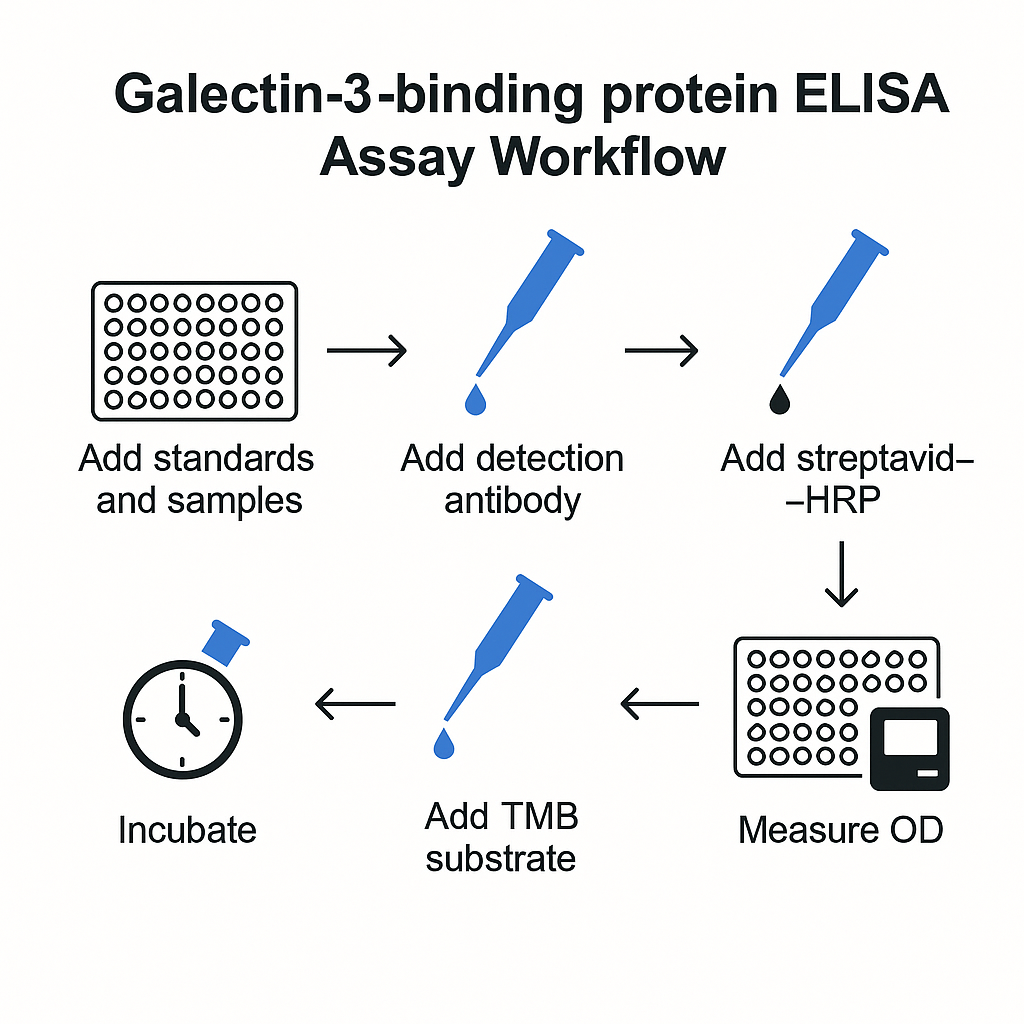
Workflow summary (RUO): coat (pre-coated in ready-to-use kits) → block → add samples/standards → wash → add detection Ab → wash → add HRP conjugate → wash → add TMB → stop → read 450 nm with 570–620 nm reference.
![AffiELISA® Dog Galectin-3 ELISA [ LGALS3]](https://affigen.com/cdn/shop/files/5BAFG-E4345_5D_20AffiELISA_C2_AE_20Cattle_20IFNg_20Kit_20High-Resolution_20Interferon_20Gamma_20ELISA_20Detection_cf72b3ec-1878-4af4-8364-0b49633e1956_535x.png?v=1712846845)
Kit components and compatible samples
Typical components (kit-dependent): pre-coated 96-well plate, Galectin-3 standard (recombinant), sample diluent, wash buffer, detection Ab, HRP conjugate, TMB, stop solution, plate sealers, and an IFU.
Common matrices: serum, plasma (EDTA/heparin/citrate), cell culture supernatant, and validated tissue lysates.
Good practices and laboratory rigor:
NIH Rigor & Reproducibility — nih.gov/research-training/rigor-reproducibility (NIH)
Biosafety guidance — cdc.gov/labs (CDC) | osha.gov/laboratory-safety (OSHA)
Chemical handling and waste — epa.gov/hw (EPA)
Sample preparation (key controls)
-
Serum/plasma: clarify by centrifugation (e.g., 10,000 ×g, 5–10 min). Avoid repeated freeze–thaw.
-
Supernatants: remove cells/debris, record culture conditions (FBS %, time).
-
Dilution linearity: pre-screen multiple dilutions (e.g., 1:2–1:16).
-
Spike-recovery: matrix-matched recovery at low/mid/high spikes (target 80–120%).
-
Interferents: hemolysis, lipemia, or high biotin may affect signals; document and mitigate.
Useful primers on standards and reference materials:
NIST Reference Materials — nist.gov/srm (NIST)
FDA Bioanalytical Method Validation (concepts also helpful for ELISA QC) — fda.gov/media/70858/download (FDA)
Protocol: validated, step-wise (condensed)
-
Equilibrate reagents to room temperature; plan a full plate map.
-
Standards: 2-fold or 3-fold serial dilutions to span the expected range.
-
Curve fit later with 4PL/5PL; keep ≥7 points + blank. See:
NCBI Bookshelf: curve fitting topics — ncbi.nlm.nih.gov/books (NIH)
-
-
Load samples in duplicate or triplicate; include negative controls and spikes.
-
Incubate per IFU (e.g., 1–2 h), then wash thoroughly (≥3–5 cycles).
-
Detection Ab → incubate → wash; HRP conjugate → incubate → wash.
-
TMB develop to target OD (e.g., 0.8–1.5 at top standard); stop with acid.
-
Read 450 nm with reference filter; export raw data (CSV).
-
Analyze with validated 4PL/5PL; back-calculate concentrations; flag out-of-range.
General data resources:
PubMed method articles — pubmed.ncbi.nlm.nih.gov (NIH/NLM)
ClinicalTrials.gov for research contexts — clinicaltrials.gov (NIH)
Performance characteristics (report and verify)
When you qualify a Galectin-3 ELISA in your lab, document:
-
Range & LLOQ: define functional range via back-calculated standards; verify LLOQ with %CV ≤20% and accuracy 80–120%.
-
Precision: intra-assay %CV (same plate) and inter-assay %CV (different days/operators).
-
Accuracy: matrix-matched spike-recovery and dilutional linearity.
-
Specificity: minimal cross-reactivity to related galectins; perform interference checks.
-
Stability: bench-top, freeze–thaw (≥3 cycles), long-term at −80 °C.
-
Robustness: small variations in incubation time/temperature and wash intensity.
For structured reporting vocabulary and documentation:
NLM Research Reporting resources — nlm.nih.gov/NIHbmic/nih_data_sharing.html (NLM)
NIH Data Management & Sharing — sharing.nih.gov (NIH)
Calibration, controls, and QC acceptance
-
Use fresh standard curves each run; keep residuals <15% across mid-range.
-
Include QC pools at low/mid/high; accept runs only if all QC levels pass preset ranges.
-
Track Levey–Jennings QC charts for trend detection (simple plotting via ImageJ/Fiji: imagej.nih.gov — NIH).
-
Archive raw reads, plate maps, and analysis scripts with timestamps (see NIST metrology principles above).
Data analysis: 4PL/5PL, outliers, and reportable result
-
Fit 4PL (asymmetric data may warrant 5PL); weight 1/y² or 1/y if heteroscedastic.
-
Define reportable range where total error meets your spec.
-
Apply an outlier policy (e.g., Grubbs) before final concentration calls.
-
Re-run samples exceeding highest standard with validated diluent.
Background on statistical treatment and validation concepts:
NIDA (NIH) statistics primers — nida.nih.gov/research/statistics (NIH)
NHLBI research resources — nhlbi.nih.gov/research (NIH)
Common issues & troubleshooting
-
Low signal: insufficient incubation, active site loss, expired TMB; verify HRP activity.
-
High background: inadequate washing, plate drying, or contaminated buffers.
-
Poor linearity: pipetting drift, standard prep error, or hook effect at very high analyte.
-
Matrix effects: switch to higher dilution, add heterophilic blocker, or use matched matrix.
-
Edge effects: equilibrate plates, avoid drafts, and use plate sealers consistently.
University tutorials that cover practical ELISA nuances:
Cornell University resources — cornell.edu (edu)
University of Arizona laboratory guides — arizona.edu (edu)
University of California resources — berkeley.edu (edu)

Applications (research only)
Galectin-3 ELISA is widely used in glycobiology, cell signaling, extracellular vesicle studies, and matrix remodeling projects. For biochemical context and glycobiology tools:
PubChem (ligands/sugars) — pubchem.ncbi.nlm.nih.gov (NIH)
NLM Research Guides — guides.nlm.nih.gov (NLM)
NIAID research resources — niaid.nih.gov/research (NIH)
Note: Content herein describes laboratory procedures for Research Use Only (RUO). Avoid clinical interpretation and ensure local governance compliance.
Documentation & compliance checklist
-
SOP aligned with institutional policies (see HHS research policy hub — hhs.gov)
-
Training logs and competency records (institutional)
-
Equipment calibration logs (plate reader verification)
-
Complete run records (raw ODs, plate map, curve, QC outcomes, final concentrations)
-
Data sharing & retention per funder/institution (NIH DMS: sharing.nih.gov)
Structured FAQ (SEO-friendly)
Q1. What detection format is best?
Most Galectin-3 kits are HRP/TMB sandwich ELISAs due to sensitivity and dynamic range; some use biotin-streptavidin systems for signal amplification (overview: NCBI Bookshelf, NIH).
Q2. What is a good acceptance criterion for precision?
For RUO quantification under typical lab conditions: intra-assay %CV ≤10–15%, inter-assay %CV ≤15–20% are commonly targeted (see FDA bioanalytical concepts for general guidance).
Q3. How many standards?
At least 7 levels plus blank across the anticipated range to support robust 4PL/5PL fits (see NIST and NIH resources above).
Q4. How to handle matrix effects?
Demonstrate parallelism (serial dilution slope vs. standard) and spike-recovery in each matrix; adjust sample dilution and blockers accordingly (CDC/NIH lab best practices).
Reference links (edu/gov) used above — quick list
-
NCBI Gene LGALS3 — ncbi.nlm.nih.gov/gene/3958 (NIH)
-
MeSH Browser — meshb.nlm.nih.gov (NIH/NLM)
-
NCI Thesaurus/Dictionaries — cancer.gov/publications/dictionaries (NCI/NIH)
-
GEO — ncbi.nlm.nih.gov/geo (NIH)
-
NCBI Bookshelf — bookshelf.ncbi.nlm.nih.gov (NIH)
-
MedlinePlus — medlineplus.gov (NLM/NIH)
-
Stanford University — stanford.edu (edu)
-
MIT OCW — ocw.mit.edu (edu)
-
NIST SRM — nist.gov/srm (NIST)
-
FDA Guidance — fda.gov/media/70858/download (FDA)