
Introduction to BL21 (DE3) Chemically Competent Cells
BL21 (DE3) Chemically Competent Cells BL21 are widely used laboratory strains of Escherichia coli designed to support efficient recombinant protein expression and plasmid-based gene expression experiments. Because of their optimized genetic background and compatibility with T7 promoter expression vectors, these competent cells have become one of the most common bacterial systems used in molecular biology laboratories and biotechnology research environments.
The BL21 lineage originates from E. coli B strains that were engineered to provide improved protein stability and high expression capacity. The BL21 (DE3) variant contains a bacteriophage-derived transcription system that enables controlled transcription of cloned genes, making it highly suitable for experiments involving recombinant protein production.
Fundamental information about bacterial genetics and molecular biology can be explored through the National Center for Biotechnology Information (NCBI):
https://www.ncbi.nlm.nih.gov
Introductory resources about genome structure and gene expression are also available through the National Human Genome Research Institute:
https://www.genome.gov
Educational materials describing molecular biology techniques can be explored through Massachusetts Institute of Technology OpenCourseWare:
https://ocw.mit.edu
Further information on bacterial genetics and molecular systems is provided by Stanford University Bioengineering:
https://bioengineering.stanford.edu
Additional teaching resources on gene expression and cellular biology are available through Harvard University’s Department of Molecular and Cellular Biology:
https://mcb.harvard.edu
Understanding the BL21 (DE3) Expression System
The Role of T7 RNA Polymerase
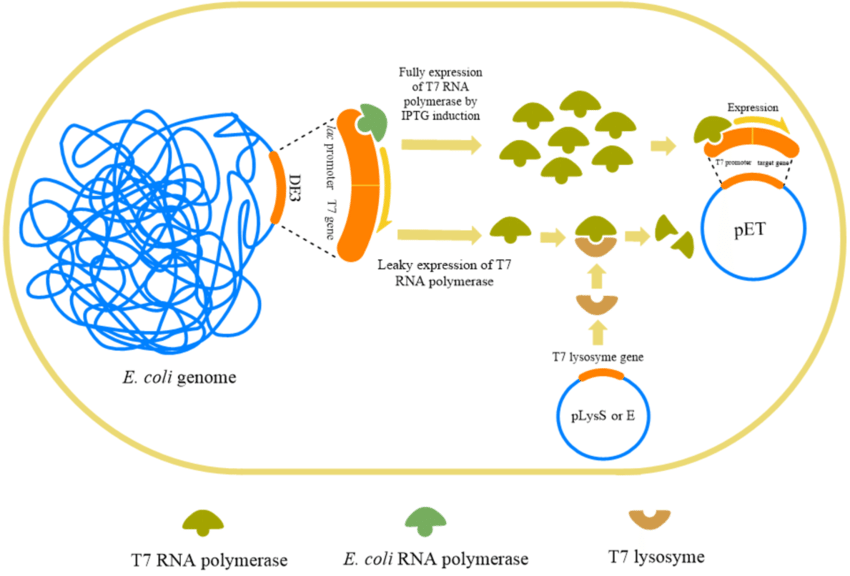
One of the defining characteristics of BL21 (DE3) competent cells is the presence of the DE3 lysogen, which carries the gene encoding T7 RNA polymerase. This enzyme specifically recognizes the T7 promoter, a powerful transcriptional control element used in many plasmid-based expression vectors.
When a plasmid containing a T7 promoter is introduced into BL21 (DE3) cells, transcription of the cloned gene can be induced under controlled laboratory conditions. This mechanism allows researchers to generate large amounts of recombinant protein from inserted DNA sequences.
Educational explanations of transcriptional systems and RNA polymerase activity can be explored through the National Institutes of Health (NIH):
https://www.nih.gov
Additional molecular biology learning resources are available through the National Library of Medicine:
https://www.nlm.nih.gov
Gene expression mechanisms are also described in detail by the University of California Berkeley Department of Molecular and Cell Biology:
https://mcb.berkeley.edu
Further educational resources about microbial genetics can be explored through the University of Washington Genome Sciences Program:
https://genome.washington.edu
Genetic Features That Improve Protein Expression
The BL21 (DE3) strain includes several modifications that make it particularly useful for recombinant protein production.
Reduced Protease Activity
BL21 (DE3) cells lack certain endogenous proteases that can degrade expressed proteins. Two notable proteases absent in this strain include:
-
Lon protease
-
OmpT protease
The absence of these proteases helps protect recombinant proteins from degradation during expression.
Educational information on protein stability and folding can be explored through the University of Wisconsin Biotechnology Center:
https://biotech.wisc.edu
Additional resources on protein biochemistry are available from the University of Cambridge Department of Biochemistry:
https://www.bioc.cam.ac.uk
Protein folding and structural biology resources can also be found at Johns Hopkins University Department of Biology:
https://bio.jhu.edu
Preparation of Chemically Competent Cells
Chemically competent cells are prepared using specialized treatments that alter the bacterial cell membrane, allowing plasmid DNA to enter the cell during transformation.
Typical chemical competence preparation methods use calcium chloride or similar reagents that temporarily increase membrane permeability.
Educational explanations of bacterial transformation methods can be found through the University of Nebraska Biological Sciences Department:
https://biosci.unl.edu
Additional laboratory teaching materials are available through Pennsylvania State University Eberly College of Science:
https://science.psu.edu
Transformation protocol descriptions can also be explored through the University of Colorado Boulder Molecular Biology Program:
https://www.colorado.edu

Transformation Workflow in BL21 (DE3) Cells
A typical transformation experiment using BL21 (DE3) chemically competent cells involves several steps.
1. DNA Preparation
A plasmid containing the gene of interest is prepared using molecular cloning techniques. The plasmid usually contains:
-
a T7 promoter
-
an antibiotic resistance marker
-
a multiple cloning site
Educational explanations of plasmid structure and cloning techniques are available through the Cornell University Biotechnology Program:
https://biotech.cornell.edu
Additional teaching resources on recombinant DNA technology are available through the University of Illinois Molecular and Cellular Biology Program:
https://mcb.illinois.edu
2. Heat-Shock Transformation
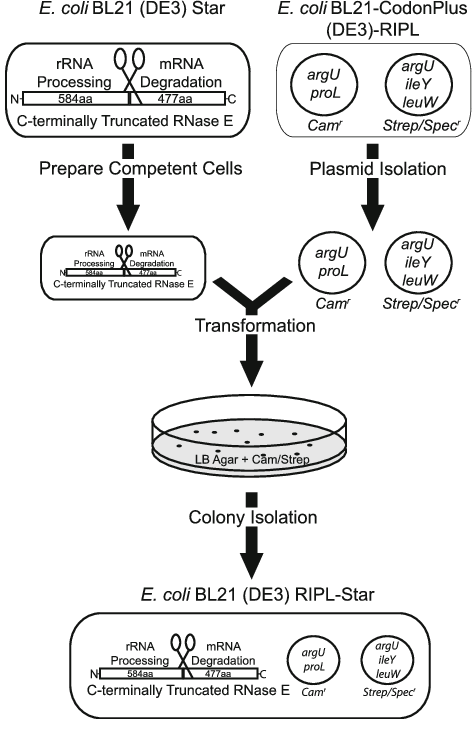
The plasmid DNA is mixed with chemically competent cells and exposed to a brief heat shock. This step allows DNA molecules to enter the bacterial cell.
Educational transformation protocols are described by the University of Florida Biotechnology Program:
https://biotech.ufl.edu
Further laboratory learning materials are available through the University of Minnesota College of Biological Sciences:
https://cbs.umn.edu
3. Selection of Transformed Colonies
After transformation, cells are plated on agar plates containing antibiotics. Only bacteria carrying the plasmid can grow on these plates.
Educational explanations of antibiotic selection in bacterial cultures can be explored through the University of Texas Molecular Biosciences Department:
https://molecularbiosci.utexas.edu
4. Induction of Gene Expression
Once transformed colonies are established, gene expression can be induced using laboratory reagents that activate the T7 RNA polymerase system.
Educational materials explaining inducible gene expression systems are available through the University of California San Diego Biological Sciences Department:
https://biology.ucsd.edu
Applications of BL21 (DE3) Chemically Competent Cells
BL21 (DE3) cells are used in many areas of molecular biology and biotechnology research.
Recombinant Protein Production
One of the most common uses of BL21 (DE3) cells is the production of recombinant proteins for biochemical studies.
Educational resources about recombinant protein expression systems can be explored through the University of Oxford Department of Biochemistry:
https://www.bioch.ox.ac.uk
Additional information about protein expression workflows is available through Yale University Molecular Biophysics and Biochemistry:
https://mbb.yale.edu
Protein Structure Studies
Proteins expressed in BL21 (DE3) cells are frequently used for structural analysis techniques such as crystallography or cryo-electron microscopy.
Structural biology data can be explored through the Protein Data Bank (RCSB) hosted by Rutgers University:
https://www.rcsb.org
Bioinformatics resources related to protein structures are available through the European Bioinformatics Institute:
https://www.ebi.ac.uk
Enzyme Characterization
BL21 (DE3) cells are frequently used for expressing enzymes used in biochemical research and industrial biotechnology.
Educational materials on enzymology are available through the University of Alberta Department of Biological Sciences:
https://www.biology.ualberta.ca
Additional resources describing enzyme function can be explored through the National Institute of General Medical Sciences:
https://www.nigms.nih.gov
Advantages of BL21 (DE3) Chemically Competent Cells
Researchers frequently choose BL21 (DE3) cells because they provide several advantages for molecular biology experiments.
Efficient Protein Expression
The T7 expression system allows strong transcription of genes cloned under T7 promoters.
Reduced Protein Degradation
The absence of key proteases helps maintain protein integrity.
Compatibility with Expression Plasmids
BL21 (DE3) cells are compatible with many widely used expression vectors including pET-based systems.
Reliable Laboratory Performance
Chemically competent BL21 cells provide consistent transformation efficiency in molecular cloning experiments.
Research Fields That Use BL21 (DE3) Cells
BL21 (DE3) competent cells support research across many scientific disciplines, including:
-
molecular biology
-
protein engineering
-
enzyme discovery
-
synthetic biology
-
structural biology
-
metabolic pathway analysis
Educational materials describing synthetic biology approaches can be explored through the MIT Synthetic Biology Center:
https://syntheticbiology.mit.edu
Further information about biological engineering research initiatives can be found through the National Science Foundation Biological Sciences Directorate:
https://www.nsf.gov
Future Developments in Bacterial Expression Systems
Bacterial expression systems continue to evolve as researchers develop improved plasmid vectors, codon optimization strategies, and expression control mechanisms.
Research initiatives supporting biotechnology innovation are described by the National Institute of Standards and Technology:
https://www.nist.gov
Additional biotechnology research resources are available through the U.S. Department of Energy Office of Science:
https://science.osti.gov
Conclusion
BL21 (DE3) Chemically Competent Cells BL21 remain a fundamental tool in molecular biology research and biotechnology laboratories. Their optimized genetic background, reduced protease activity, and compatibility with T7 promoter expression systems allow efficient expression of recombinant proteins in bacterial cells.
Because of these advantages, BL21 (DE3) cells continue to support research in protein engineering, enzyme characterization, structural biology, and many other areas of modern biotechnology.